Saturday, March 10, 2018

LAD/Blog #35: Home was a Horse Stall

Home was a Horse Stall

Reactions to Sox:
  • I think it is really awful that, on top of being executed, the Japanese Americans felt forced to burn everything directly related to their culture, as it could be taken as a threat or a sign of collaboration with the enemy
  • Sox's personal story also makes me think about these people were being treated as if they directly betrayed the US, instead of the reality where it was their home country
  • I can't imagine living with four other people in a 9- by 20-foot enclosure, even if they were family, and especially in those unsanitary conditions
  • Her good fortune as the assistant block manager also reminds me how others were not as fortunate
President Roosevelt's Executive Order: 
  • The Executive Order 9066 allowed Roosevelt to establish "military areas" along the West Coast and limit activities of the people in those areas
  • The Civilian Exclusion Order No. 27 (two months later) narrowed the focus of these restrictions to "all persons of Japanese ancestry, both alien and non-alien"
  • These orders disrupted the lives of 112,000 people, two-thirds of them US citizens
  • Evacuation orders were soon posted, and Japanese Americans had to prepare to leave (May 9, 1942 was leaving day)
  • The exclusion order was lifted on November 11, 1944
1988 "Repair":
  • The Civil Liberties Act of 1988 was passed as an attempt for the government to try to compensate for all of the terror previously conflicted on the Japanese Americans
  • With this law, each surviving person received $20,000 as a symbolic reparation for their hardship, and provided compensation for Aleut people of Alaska who were relocated from their homes after a Japanese invasion
  • This act also established a fund for educating the public about the internment
The concentration camps of the Holocaust are probably the closest synthesis to the camps in the US in the 1940's.  But for US history, it can be said that slavery was pretty close.  People were trapped working for other people, in filthy conditions, and were greatly mistreated due to the color of their skin (the Japanese Americans were pitted against due to their nationality, even though they were US citizens).

Saturday, March 3, 2018

LAD/Blog #34: FDR's First Inaugural

FDR's First Inaugural Address (1933)
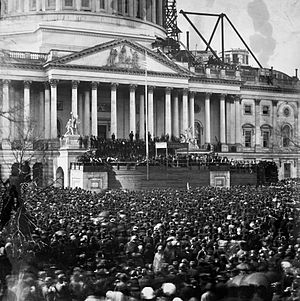
  • FDR's first inaugural address, which was very memorable, was made on March 4th, 1933
  • One of the most famous quotes of his is right in the beginning of his speech: "So, first of all, let me assert my firm belief that the only thing we have to fear is fear itself"
  • This quote was very inspirational and motivational for American citizens during this time period (the Great Depression)
  •  FDR also mentions how it is very important that they focus on the existing truth, and brings up how the Great Depression really wasn't severe as rumors were making it out to be
  • The address shows FDR's optimism, without the pure idealism or ignorance of previous presidents 
  •  He carefully explains how the situation really isn't as bad, since everything was focused around materialistic things, substances that the American people really did not need to live, and how it could be much worse with other things such as disease
  • FDR uses the current state of America to spread hope of the future while still acknowledging the struggles to come
  • He also explains how other leaders before him fell short due to their fear, and how he aims to take action in a different way, with God's blessing
  • "Happiness lies not in the mere possession of money; it lies in the joy of achievement, in the thrill of creative effort"
George Washington's inaugural address was similar to FDR's first one, for several reasons.  First, both speeches were very memorable, as Washington was the first President, and FDR's was very motivational and during a time of economic downfall for the country.  In addition, both of them clearly outline their beliefs, along with actions they hope to take in the future to make the nation even better.  They focus on the truth of the situation they are in, and how they plan on making the best of it.

Friday, March 2, 2018

LAD/Blog #33: Kellogg-Briand Peace Pact

Kellogg-Briand Peace Pact (1928)
  • This agreement to outlaw war was signed on August 27th, 1928
  • AKA the Pact of Paris (the city where it was signed)
  • Another international effort to prevent a future world war
  • Nicholas Murray Butler and James T. Shotwell were two peace advocates involved in the
    Carnegie Endowment for International Peace organization
  • French Minister of Foreign Affairs Aristide Briand proposed the peace act between the US and France with help from Butler and Shotwell
  • President Calvin Coolidge and Secretary of State Frank B. Kellogg were more wary towards the peace act, because it could easily turn into an alliance where the US would have to step in to defend France in case of conflict
  • Because of this, Kellogg and Coolidge proposed turning the pact into one for all countries, not just between the US and France (which was well-recieved internationally)
  • A total of 62 nations ended up signing the pact, including Germany
  • It was also ratified by the US Senate with a vote 85-1
  • There was ultimately no way to enforce the pact, or even define what "self-defense" meant for each country
  • The first major test of this pact was in 1931, with the Mukden Incident, which led to the Japanese invasion of Manchuria (even though Japan had signed the pact)
  • This incident proved that it was nearly impossible to enforce the act, especially for multiple countries 
  • The legacy of the pact remains as a statement of the idealism of the time period
  • Kellogg won the Nobel Peace Prize in 1929 for his work on the pact
Wilson's 14 points were very similar to the Kellogg-Briand Peace Pact of 1928.  Both of them were very idealistic, with a goal for world peace with the pact and Article X of the Treaty of Versailles, also known as the League of Nations and Wilson's fourteenth point.  The common problem with these two things was also that there was no real way to enforce the ideas of peace, causing them both to be unsuccessful.

Saturday, February 10, 2018

LAD/Blog #32: Wilson's 14 Points of Peace


President Wilson's 14 Points of Peace can be seen as more idealistic, as a whole, than realistic.  As a president aware of America's past history, Wilson most likely would have seen that achieving world peace would not be nearly as easy as his points make it out to be.  It seems that since Wilson thought he had no choice but to declare war on Germany, he tried to use his 14 Points to make his decision appear more justified for Americans.  Considering the new use of the U-boats and submarines by Germany, it seems that Wilson's second point about absolute freedom of the seas was definitely more idealistic.  Equal trade, seen in the third point, also is more idealistic due to different countries constantly having different tariff rates and own economic interests.  Including Russia in his points is also more idealistic, since Wilson really had no control over what was going on in Russia at the time, even if he indirectly impacted the country by entering the Great War.  Similarly, the points go on to talk about Belgium, France, Italy, Austria-Hungary, etc.  All of these conditions for peace would have to be agreed on by all of these countries, and Wilson makes it sound so simple in these points purely so that he can keep thinking of the ideal world.  In the fourteenth and final point, Wilson describes the creation of an association of nations that would prevent future wars, as the Great War was also originally referred to as "the war to end all wars."  The irony in this is that even though the League of Nations was created in 1920, only two years after the end of the war, the United States did not join the league, and it was not successful in preventing wars, seen in WWII.  It wasn't until the United Nations, founded in 1945, that the US joined such an association, and that it was successful.

President Wilson's 14 Points of Peace can easily be related to the outcomes of the Great War.  For example, the Treaty of Versailles was made at the Paris Peace Conference in 1919, with several countries meeting, including the US, to decide how to deal with the aftermath of the war.  Since Wilson's points are mainly idealistic instead of realistic, this was supported when the treaty was not even passed by the Senate, and how the League of Nations (1920) was unsuccessful in preventing future wars.

Wednesday, January 31, 2018

LAD/Blog #31: Schenck V. United States

Schenck V. United States (1919)
  •  Schenck was charged in 1919 with an intended plan to act against the Espionage Act made two years prior
  • He made attempts to encourage insubordination within the military in order to block the recruitment going on during that time period
  • The vote was unanimous within the Supreme Court, which decided that only Congress has the right to limit rights stated in the First Amendment during times of war (such as the freedom of speech, which was violated by Schneck)
  • The "clear and present danger" mentioned by Justice Oliver Wendell Holmes Jr. is the desire of people to violate rights guaranteed to all by the Constitution (in this case, the First Amendment), bringing an unwelcome evil into the country
  • Holmes explains how cases like these vary based on the circumstances at the time; for example, during wartime, offenses that would otherwise be overlooked will not be left  unpunished
    Besides both being Supreme Court cases, Marbury V. Madison and Schneck V. United States had more in common by becoming establishment cases.  In Schneck V. United States, it was established that Congress had the right to determine punishments during times of war and times of peace, and that these punishments could and would be different depending on the time if anyone was denied basic rights guaranteed in the Constitution.  Likewise, the case Marbury V. Madison stated that the Supreme Court had the right to declare a law unconstitutional, also known as judicial review.  The following cases would not have been possible or justified without this new concept of judicial review, and it set the tone for the judiciary branch of government for years to come.

Thursday, January 18, 2018

LAD/Blog #30: Wilson's First Inaugural

  • Wilson starts off by mentioning the domination of the Democratic Party, and how he hopes to change this in the upcoming years
  • looks down upon America's former successes, due to the destruction of nature, high death rates, waste, over-taxation, and losing sight of the voice of the people
  • is very progressive in this sense, as he mentions a whole list of changes that need to be made in the government and country
  • "our work is a work of restoration," believes in correcting all that is wrong with America
  • addresses tariffs, the banking system, industrialization, and the environment, saying that they all are areas that need work
  • believes it is the duty of the government to protect the people
  • says it is necessary to establish laws for sanitation, food and drugs, and working conditions
  • his address is a promise to the people that change will come, and that it will benefit the American people
Wilson's Inaugural Address was very similar to Lincoln's Inaugural Address.  Both presidents talked about reforms that were necessary for the country's survival, and why they felt so.  In addition, both presidents clearly state their views for the country to hear: Lincoln establishes his stance on slavery, and Wilson talks about progressive reform.

LAD/Blog #29: Clayton Anti-Trust Act


Clayton Anti-Trust Act (1914)
  • constructed by President Wilson
  • more detailed than the Sherman Antitrust Act
  • prohibited: competitive price discrimination, exclusive dealing practice, and anti competitive mergers
  • allowed: private parties to sure and union organizing
  • all prices of goods of equal value and quality must be equal
  • price fixing was a previous violation in the Sherman Act
  • unlike the Clayton Act, the Sherman Act did not distinguish between price fixing with goods and price fixing with labor
  • under the act, large mergers have to be reported to either the Department of Justice or the Federal Trade Commission
    The Sherman Act and the Clayton Act were obviously very similar, as the common goal of both acts was to break up trusts by involving the government in business practices.  Even though the Sherman Act had more of an impact and the Clayton Act was more specifically laid out, both acts were successful to a degree in regulating business as the government shifted from laissez-faire to more hands-on.