Saturday, February 10, 2018

LAD/Blog #32: Wilson's 14 Points of Peace


President Wilson's 14 Points of Peace can be seen as more idealistic, as a whole, than realistic.  As a president aware of America's past history, Wilson most likely would have seen that achieving world peace would not be nearly as easy as his points make it out to be.  It seems that since Wilson thought he had no choice but to declare war on Germany, he tried to use his 14 Points to make his decision appear more justified for Americans.  Considering the new use of the U-boats and submarines by Germany, it seems that Wilson's second point about absolute freedom of the seas was definitely more idealistic.  Equal trade, seen in the third point, also is more idealistic due to different countries constantly having different tariff rates and own economic interests.  Including Russia in his points is also more idealistic, since Wilson really had no control over what was going on in Russia at the time, even if he indirectly impacted the country by entering the Great War.  Similarly, the points go on to talk about Belgium, France, Italy, Austria-Hungary, etc.  All of these conditions for peace would have to be agreed on by all of these countries, and Wilson makes it sound so simple in these points purely so that he can keep thinking of the ideal world.  In the fourteenth and final point, Wilson describes the creation of an association of nations that would prevent future wars, as the Great War was also originally referred to as "the war to end all wars."  The irony in this is that even though the League of Nations was created in 1920, only two years after the end of the war, the United States did not join the league, and it was not successful in preventing wars, seen in WWII.  It wasn't until the United Nations, founded in 1945, that the US joined such an association, and that it was successful.

President Wilson's 14 Points of Peace can easily be related to the outcomes of the Great War.  For example, the Treaty of Versailles was made at the Paris Peace Conference in 1919, with several countries meeting, including the US, to decide how to deal with the aftermath of the war.  Since Wilson's points are mainly idealistic instead of realistic, this was supported when the treaty was not even passed by the Senate, and how the League of Nations (1920) was unsuccessful in preventing future wars.

Wednesday, January 31, 2018

LAD/Blog #31: Schenck V. United States

Schenck V. United States (1919)
  •  Schenck was charged in 1919 with an intended plan to act against the Espionage Act made two years prior
  • He made attempts to encourage insubordination within the military in order to block the recruitment going on during that time period
  • The vote was unanimous within the Supreme Court, which decided that only Congress has the right to limit rights stated in the First Amendment during times of war (such as the freedom of speech, which was violated by Schneck)
  • The "clear and present danger" mentioned by Justice Oliver Wendell Holmes Jr. is the desire of people to violate rights guaranteed to all by the Constitution (in this case, the First Amendment), bringing an unwelcome evil into the country
  • Holmes explains how cases like these vary based on the circumstances at the time; for example, during wartime, offenses that would otherwise be overlooked will not be left  unpunished
    Besides both being Supreme Court cases, Marbury V. Madison and Schneck V. United States had more in common by becoming establishment cases.  In Schneck V. United States, it was established that Congress had the right to determine punishments during times of war and times of peace, and that these punishments could and would be different depending on the time if anyone was denied basic rights guaranteed in the Constitution.  Likewise, the case Marbury V. Madison stated that the Supreme Court had the right to declare a law unconstitutional, also known as judicial review.  The following cases would not have been possible or justified without this new concept of judicial review, and it set the tone for the judiciary branch of government for years to come.

Thursday, January 18, 2018

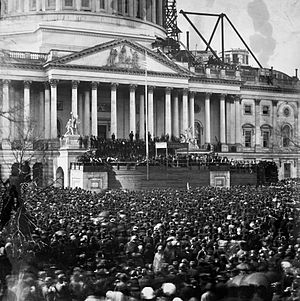
LAD/Blog #30: Wilson's First Inaugural

  • Wilson starts off by mentioning the domination of the Democratic Party, and how he hopes to change this in the upcoming years
  • looks down upon America's former successes, due to the destruction of nature, high death rates, waste, over-taxation, and losing sight of the voice of the people
  • is very progressive in this sense, as he mentions a whole list of changes that need to be made in the government and country
  • "our work is a work of restoration," believes in correcting all that is wrong with America
  • addresses tariffs, the banking system, industrialization, and the environment, saying that they all are areas that need work
  • believes it is the duty of the government to protect the people
  • says it is necessary to establish laws for sanitation, food and drugs, and working conditions
  • his address is a promise to the people that change will come, and that it will benefit the American people
Wilson's Inaugural Address was very similar to Lincoln's Inaugural Address.  Both presidents talked about reforms that were necessary for the country's survival, and why they felt so.  In addition, both presidents clearly state their views for the country to hear: Lincoln establishes his stance on slavery, and Wilson talks about progressive reform.

LAD/Blog #29: Clayton Anti-Trust Act


Clayton Anti-Trust Act (1914)
  • constructed by President Wilson
  • more detailed than the Sherman Antitrust Act
  • prohibited: competitive price discrimination, exclusive dealing practice, and anti competitive mergers
  • allowed: private parties to sure and union organizing
  • all prices of goods of equal value and quality must be equal
  • price fixing was a previous violation in the Sherman Act
  • unlike the Clayton Act, the Sherman Act did not distinguish between price fixing with goods and price fixing with labor
  • under the act, large mergers have to be reported to either the Department of Justice or the Federal Trade Commission
    The Sherman Act and the Clayton Act were obviously very similar, as the common goal of both acts was to break up trusts by involving the government in business practices.  Even though the Sherman Act had more of an impact and the Clayton Act was more specifically laid out, both acts were successful to a degree in regulating business as the government shifted from laissez-faire to more hands-on. 

LAD/Blog #28: Keating-Owen Child Labor Act

 Keating-Owen Child Labor Act (1916)
  • proposed by Senator Albert J. Beveridge
  • the act used Congress's ability to regulate interstate commerce
  • prohibited the sale of any goods produced through child labor under these conditions: any child under 14 and any mine worker under 16
  • also prohibited the sale of any goods produced in a business that had children under 16 working at night or for more than 8 hours during the day
  • the act was repealed by the Supreme Court in Hammer V. Dagenhart
  • was effective in improving working conditions and hours while it lasted
The Sherman Antitrust Act of 1890 was actually very similar to the Keating-Owen Child Labor Act of 1916.  Both acts were made during a progressive time period, and were steps taken by the government to regulate businesses.  In the Keating-Owen Child Labor Act, wages, hours, and working conditions established by businesses were regulated by Congress in order to put an end to the dangerous child labor.  Similarly, in the Sherman Antitrust Act, the government began taking steps away from laissez-faire and towards regulation, in order to break up trusts and take power away from the businesses. 

Monday, January 8, 2018

LAD/Blog #27: MLK, Jr.'s "I Have a Dream" Speech

 August 28, 1963
Civil Rights Act of 1963:
  • the people joined together to "cash a check," in other words make sure that they were given the same rights of life, liberty, and the pursuit of happiness (as promised by the Constitution)
  • MLK Jr.'s speech was made one hundred years after the signing of the Emancipation Proclamation, yet black men were still not treated the same as white
  • this law and the expected result had been long anticipated by many people, both black and white
  • MLK Jr. discusses how they will not be silenced or satisfied with the way blacks have been treated in the past, further showing how the act was long overdue
    Favorite Dreams:
    • "I have a dream that one day on the red hills of Georgia the sons of former slaves and the sons of former slave owners will be able to sit down together at a table of brotherhood." I really like this particular dream because I think it is important to not let the past define the future, and this dream shows how the change could be possible with former enemies (and the generations to come) becoming friends.
    • "I have a dream that my four children will one day live in a nation where they will not be judged by the color of their skin but by the content of their character." I think that this dream is really important because racism is still such a strong topic today, so the importance is still very relevant, and in addition it can be debated how much this dream has come true over the years.
    • "I have a dream that one day the state of Alabama, whose governor's lips are presently dripping with the words of interposition and nullification, will be transformed into a situation where little black boys and black girls will be able to join hands with little white boys and white girls and walk together as sisters and brothers." Lastly, I really agree with and like this dream because it brings up the idea that racism and discrimination are things that are taught, not naturally developed.  If children can play together despite their differences in appearances, why can't adults do the same, as they were once children themselves?
    Frederick Douglass and MLK Jr. were two very similar men.  They shared the same beliefs against slavery and towards equal rights for all.  In addition, Douglass is well known for his Fourth of July speech while MLK Jr. is remembered for his "I Have a Dream" Speech. 

    Wednesday, December 20, 2017

    LAD/Blog #26: William Jennings Bryan's "Cross of Gold" Speech

    Summary:
    • "the most famous political speech in American history"
    • the speech was delivered on July 9, 1896 at the Democratic National Convention in Chicago
    • Bryan- 36 at the time, former Congressman from Nebraska
    • used drama and rhetoric to gain the support of the people, which later got him on the Presidential ballot
    • states his cause to be humanity
    • seems to believe in the people as a whole, instead of just individuals against each other
    • "the man who is employed for wages is as much as businessman as his employer"
    • speaks of peace and unity
    • race is a matter of principle
    • supports the Democratic income tax law
    • supports the struggling mass of workers who support the US economy
    • Andrew Carnegie's Gospel of Wealth is very similar to William Jennings Bryan's "Cross of Gold" Speech.  Both of these men talked about their opinions on the difference between the social and economic classes, and how the gap existing should be made smaller.  Both believed in unity, and influenced Americans with their economic opinions.